At a group exhibition a few years ago, a visitor came up to me and said that they’d looked down the list of works and seen the title Moderate or Good.
“I just had to go find that painting immediately,” they said.
I don’t remember if anything was expressed about the visual qualities of the work, I was far too delighted by the allure of my title.
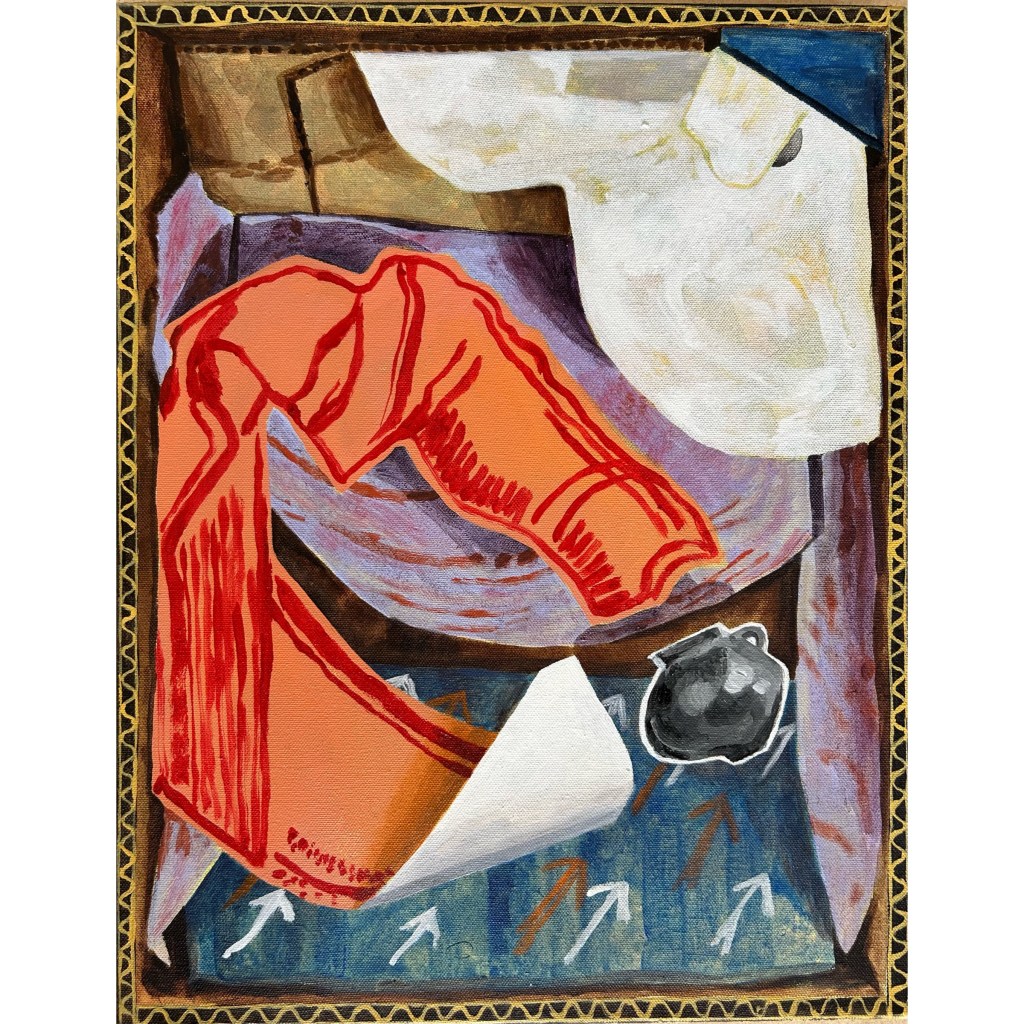
2024, acrylic and oil on canvas, 46 x 36 cm
The naming of works is an essential part of my practice and I feel unable to reveal work that has yet to be baptised. I’ve had long conversations with a certain type of purist who believes that the work should speak for itself and would name every work Untitled if they could. I almost understand this, that is to say, I don’t understand at all; art works have never spoken for themselves, now less so than ever, and have always been interpreted within a historical, religious, cultural, biographical, critical, institutional framework so why not help it all along. Saying titles are superfluous is rather like saying that condiments aren’t necessary to a meal, when it’s clear that a dose of mustard can set off a dish to perfection. How drab would life be without mayonnaise, horseradish sauce and ketchup.
Dismember my Monster
Between the Ribs
Cloud Kit
Cloud Kit XL
Monster Munch
Charybdis Loves You
Personal Growth
Some titles you find, and some titles find you. There are titles which come into existence alongside the inception of a work, others trickle in long after the race is finished. My husband has an uncanny knack of coming up with the perfect nickname or phrase to describe a person or activity (rarely complimentary); these I have occasionally borrowed and put to use. I often steal from literature; from fairytales, nursery rhymes, Greek myths, poetry, novels I’m reading at the time of making. When the title lands, it becomes fixed and indelible. It becomes part of the work. It feels like it was always there, waiting.
Lotions and Potions
Cloud of Witnesses
Magic Mountains
Goblin Market
Chop Chop
Newborn
Titles are more than a means of differentiation and cataloguing. They can hint at a secret that might not be obvious in a work; one the artist is not willing to share in full. Titles can give an alternate reading that make a viewer look again to solve the puzzle. Think of the best children’s picture books where the text and the image impart two quite different ideas, which when taken as a whole form humorous juxtaposition or conjure a richer emotion. Alternatively, sometimes it’s quite nice to call a spade a spade (unless you’ve never seen a spade). Or if one is feeling cheeky, make the title lie or misdirect by saying a work is about a spade when it’s actually about a sharpened pitchfork. Why pretend neutrality in a world where everything is partisan.
 Lottie Stoddart
You must be logged in to post a comment.